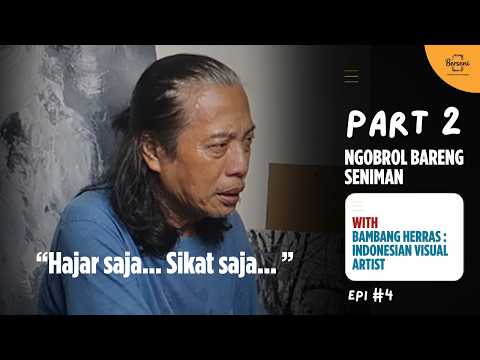
“Whether It Sells or Not, Whether I Have Money or Not… I Keep Working” | Berseni Podcast
In an artist’s journey, creating art does not always go hand in hand with appreciation, sales, or ideal life circumstances. There are times when a work receives attention, and there are also times when the canvas, ideas, and time invested do not necessarily result in something that can be sold.
Yet for Bambang Herras, these circumstances are never a reason to stop.
“Whether it sells or not, whether I have money or not… I keep working.”
This simple statement reflects Bambang Herras’ attitude and mindset throughout his journey as an artist.
Continuing the conversation from the previous episode, in Part 2 of the Berseni Podcast, Bambang Herras invites us to take a closer look at the realities of being a visual artist: how to persevere, how to maintain the motivation to create, and how to keep finding reasons to paint when circumstances do not always work in your favor.
Being an artist is not simply about creating beautiful works of art. Behind every painting lies a long process involving ideas, experiences, questions, discussions, and the courage to keep exploring.
For Bambang, a work of art should not simply be “good” visually. It should also carry substance and ideas—something that the artist wants to communicate, explore, or express through the work.
This is where the artistic process becomes more than simply putting images onto a canvas.
One of the greatest challenges artists face is when ideas simply do not come. Creative blocks can be part of the journey, even for artists who have spent years in the art world. But Bambang has his own way of dealing with them.
Community discussions and painting directly on location, or on the spot, have become spaces for him to rediscover creative energy. Engaging with the environment, observing places firsthand, and exchanging ideas with others can open up new possibilities that may not emerge when an artist simply stays inside the studio.
This experience has even taken him to paint in various places, from temples and historical sites to Istanbul.
His journey shows us that inspiration does not always have to be found deep within our own minds. Sometimes, it comes from the places we visit, the people we meet, the conversations we have, or the atmosphere we experience firsthand.
At the same time, being an artist also means being prepared to face criticism.
A work that we consider important may not receive the same response from others. The value of a work cannot always be measured simply by whether it sells or not.
That is why learning how to respond to criticism and other people’s judgments becomes an important part of an artist’s growth.
And perhaps this is one of the most meaningful lessons from Bambang Herras’ journey:
A work that has not sold does not mean that it has no value.
Likewise, difficult financial circumstances do not mean that an artist has to stop creating.
Watch Part 2 of the Berseni Podcast with Bambang Herras until the end and discover a new perspective on maintaining passion, ideas, and dedication throughout the long journey of becoming an artist.